
December 11, 2022 Advent 3 St. Andrew Church Rev. Anne McAnelly
First Lesson: Psalm 146:5-10
5 Happy are those whose help is the God of Jacob,
whose hope is in the Lord their God,
6 who made heaven and earth,
the sea, and all that is in them;
who keeps faith forever;
7 who executes justice for the oppressed;
who gives food to the hungry.
The Lord sets the prisoners free;
8 the Lord opens the eyes of the blind.
The Lord lifts up those who are bowed down;
the Lord loves the righteous.
9 The Lord watches over the strangers;
he upholds the orphan and the widow,
but the way of the wicked he brings to ruin.
10 The Lord will reign forever,
your God, O Zion, for all generations.
Praise the Lord!
Second Lesson: Mathew 11:2-11
When John heard in prison what the Messiah was doing, he sent word by his disciples 3 and said to him, “Are you the one who is to come, or are we to wait for another?” 4 Jesus answered them, “Go and tell John what you hear and see: 5 the blind receive their sight, the lame walk, those with a skin disease are cleansed, the deaf hear, the dead are raised, and the poor have good news brought to them. 6 And blessed is anyone who takes no offense at me.” 7 As they went away, Jesus began to speak to the crowds about John: “What did you go out into the wilderness to look at? A reed shaken by the wind? 8 What, then, did you go out to see? Someone dressed in soft robes? Look, those who wear soft robes are in royal palaces. 9 What, then, did you go out to see? A prophet? Yes, I tell you, and more than a prophet. 10 This is the one about whom it is written,
‘See, I am sending my messenger ahead of you,
who will prepare your way before you.’
11 “Truly I tell you, among those born of women no one has arisen greater than John the Baptist, yet the least in the kingdom of heaven is greater than he.
Mary waits on the bulletin cover. John asks if Jesus is the one, or are we to wait for another?
Palestinians wait to return to their land. We are all waiting for Christmas and Jesus to arrive. Yet
you gotta wonder why John who has been proclaiming Jesus, preparing the way for the Lord,
asks this question now, while he is imprisoned. It is a function of expectations. John preached
repentance, judgment, fire and brimstone, expecting a Messiah who would conquer the Romans
and clean house. “Instead, what John hears and sees is one who brings forgiveness, healing, and
mercy. Only Matthew’s Jesus explicitly says, “I desire mercy and not sacrifice,” not once but
twice (9:13; 12:7)” (Working Preacher, James Boyce). Jesus says to his disciples, “Go and
Tell.” The disciples hear and see that the blind see, the lame walk, lepers are cleansed, the deaf
hear, the dead are raised. They see mercy, not the expected Messiah.
Over and over again while traveling through the West Bank we heard, “Come and See and then
Go and Tell” because things can only change when people know what is really happening. On
this the third Sunday of Advent, the Sunday of Peace, I want to share a startling image I saw
upon driving into Bethlehem for the first time. I was curious about this Biblical place, the place
of Christ’s birth, the place of the manger and holy family. But as our large tour bus made its way
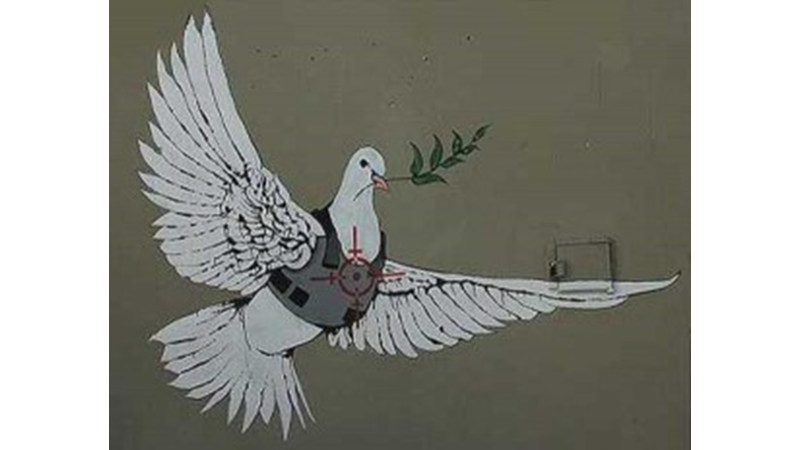
through the narrow streets, I took this picture out my window. Talk about shifting expectations.
It is the dove of peace, with an olive branch in its mouth, reminiscent of the end of the flood and
beginning of the reign of the Prince of Peace. But look closely, it has a bullet proof vest with
cross hairs on its chest. This was on the side of a garage. But the original one was painted on
the wall dividing Palestine and Israel. The artist Banksy created this image in 1974 to express the
growing tensions and the fact peace cannot be made when the people involved do not want it.
This is the separation wall that partitions the Palestinians from Israeli jobs, freedom of
movement and a better life. This wall runs right through Bethlehem, constricting the West Bank.
Note the disparity. We also toured the wall filled with protest graffiti. Note the Israeli military
tower and the image next to it. The wall was started in 2000 restraining Palestinians within the
West Bank. Israel claims it is a security wall, but it is wall of oppression, much like our border
wall. This Mandela quote on the wall, expresses solidarity. (Pause)
A few nights later we went to the Walled Off Hotel a play on the Waldorf Hotel, making a
political statement. The minute you walk through the doors, you know. Old Israeli surveillance
cameras pointed at you. British tea sets poking at the Balfour Declaration which instigated much
of this conflict. We toured the museum depicting history from the Palestinian perspective with
the Balfour Declaration 1917 where Great Britain sought to create a national home for Jews in
Palestine as part of the British Mandate. Here is a map of the region. Great Britain was given a
mandate over the old Ottoman region we now call the Holy Lands. For 25 years Great Britain
oversaw the area, until they withdrew in 1948 handing the issue to the United Nations. Two
peoples with competing claims to the land were left to without governance or clarity. Yet the
plan all along was a two-state solution, but Palestine is still waiting.
We had a delicious dinner and were entertained with live music. Banksy, the artist and activist,
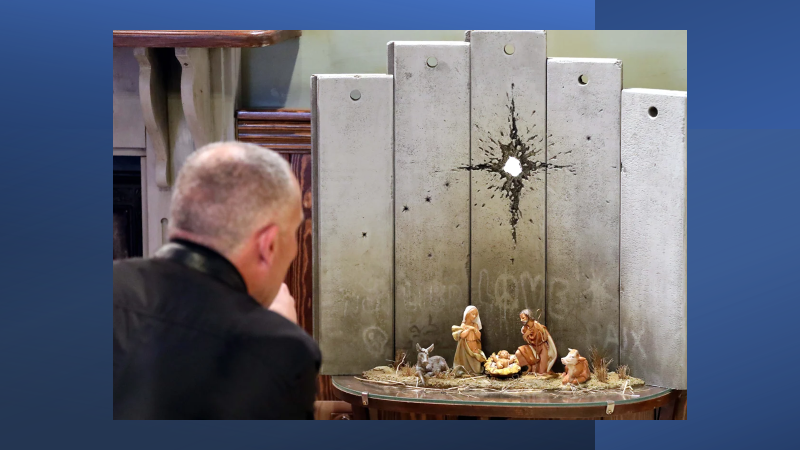
created and curated the message and art of the Walled Off Hotel. What stuck with me the most
is “Scar of Bethlehem” a serene manger scene of the Mary Joseph and baby Jesus in Bethlehem with the Israeli Wall behind. At first it looks like a star above the stable we have seen so many
times, but instead it is the artillery hole.
Continuing the gospel lesson Matthew 11:11-15 Let anyone with ears, listen. Jesus is saying that
to us. “The violent take it by force” (12). Our unconditional support of Israel must stop because
they are not working for peace, they are oppressing the Palestinians out of their land. Our 4
billion tax dollars sent every year to Israel enables this oppression. Jesus called us to peace; he is
the Prince of Peace. We get to work to bring greater peace into God’s created world.
Earlier in Matthew Jesus said, “Blessed are the peacemakers, for they shall be called children of
God” (5:9). He said those words on the Mount of Beatitudes. A tranquil spot on the Sea of
Galilee. Here the sun sets over this large body of water. Here we shed our shoes to place our
feet in the water. Here is the church built to honor our Savior’s teachings. Blessings is a theme
in Matthew’s gospel, code for God’s good news of mercy and grace. Yet Jesus says, ‘Blessed is
anyone who takes no offense at me’ (11:6). Here Jesus is leaning into John’s question, are you
the one? Do we see Jesus as the one who will bring salvation and healing? One commentator
writes, “To hear and see in this way is to acknowledge that Jesus is indeed the one who is
coming as God’s Messiah. It is to believe that there is power for new creation in God’s call to
each of us as disciples, to be transformed by repentance to bear fruits of love and mercy. It is to
know that the deeds and words of renewal and hope that take shape in our world because of him
through us and through others are marks of God’s salvation. All of these are ways of talking
about the “blessing” of God. What will we make of this Jesus? Is he indeed the Messiah? (The
Messiah) For us? If not, how will we be opened to hear and see him as Messiah in such a way that he
becomes the very reality of God’s blessing in our lives?” (Working Preacher, James Boyce).
How we see Jesus, how we welcome him in our lives during this Advent season makes a
difference? Especially since we have been given a very great distinction. What do I mean?
Jesus has affirmed that John is the one preparing the way for the Lord (10).
John is Elijah in that he is the one foretold before the arrival of the Messiah (14).
And John is the greatest of those born of women (11). That is quite a testimony to John.
But then Jesus puts a spin on it. “Yet the least in the kingdom of heaven is greater than he (11).
What does that mean? One commentator writes, “John is extolled as the greatest of human
beings (11:11a). Yet there are persons even greater (11:11b)! They are greater in the sense that,
while John stood before the coming of the kingdom, the disciples of Jesus (even the least of
them) stand within it. The response of Jesus to John’s question is to portray messiahship in a new
way” (Working Preacher, Arland J Hultgren). That means you and I are part of God’s kingdom.
We are called to be peacemakers, to share the love of God and to welcome baby Jesus not only
into our hearts, but into lives. We are blessed and we are here, we are working for peace in
God’s kin-dom.
I know this is not the Kumbaya Advent sermon you are used to, but it is a reconning of what it
means to truly receive Jesus as the Prince of Peace, who has called us to be peacemakers and
who absolutely is the One we wait for, the Messiah, and our Lord.
As we consider how to be peacemakers, I want to share something Faraj, our Palestinian
Christian tour guide, said. We were talking about the dove of peace; you know the one with the
olive branch. He said in his culture, they do not refer to the dove of peace as the dove of peace,
but rather the Pigeon of Peace. I looked that up and found that many cultures call this symbol of
peace a Pigeon of Peace. On this Advent Sunday of Peace let us be open to a Pigeon of Peace or
a Dove a Peace as we seek to be peacemakers in our part of the world. Amen.
(Pictures were shown from my trip)
