
December 18, 2022 Advent 4 St. Andrew Church Rev. Anne McAnelly
First Lesson: Psalm 80:1-3, 17-19
1 Give ear, O Shepherd of Israel, you who lead Joseph like a flock! You who are enthroned upon the cherubim, shine forth 2 before Ephraim and Benjamin and Manasseh. Stir up your might, and come to save us! 3 Restore us, O God; let your face shine, that we may be saved.
17 But let your hand be upon the one at your right hand, the one whom you made strong for yourself. 18 Then we will never turn back from you; give us life, and we will call on your name. 19 Restore us, O Lord God of hosts; let your face shine, that we may be saved.
Second Lesson: Luke 1:26-38
26 In the sixth month the angel Gabriel was sent by God to a town in Galilee called Nazareth, 27 to a virgin engaged to a man whose name was Joseph, of the house of David. The virgin’s name was Mary. 28 And he came to her and said, “Greetings, favored one! The Lord is with you.” 29 But she was much perplexed by his words and pondered what sort of greeting this might be. 30 The angel said to her, “Do not be afraid, Mary, for you have found favor with God. 31 And now, you will conceive in your womb and bear a son, and you will name him Jesus. 32 He will be great and will be called the Son of the Most High, and the Lord God will give to him the throne of his ancestor David. 33 He will reign over the house of Jacob forever, and of his kingdom there will be no end.” 34 Mary said to the angel, “How can this be, since I am a virgin?” 35 The angel said to her, “The Holy Spirit will come upon you, and the power of the Most High will overshadow you; therefore the child to be born will be holy; he will be called Son of God. 36 And now, your relative Elizabeth in her old age has also conceived a son, and this is the sixth month for her who was said to be barren. 37 For nothing will be impossible with God.” 38 Then Mary said, “Here am I, the servant of the Lord; let it be with me according to your word.” Then the angel departed from her.
Beauty is in the eye of the beholder. We have all heard that before. Plato pondered this idea in 3C BCE. In the 18th century David Hume wrote, “Beauty in things exists merely in the mind which contemplates them.” Beauty is subjective. It is relative to others and norms. I started thinking about beauty while thinking about Mary being the favored one. Twice the angel calls Mary favored (28,30). “Greetings favored one! The Lord is with you.” “You have found favor with God.” Favored means beloved, cherished, precious and preferred. Who wouldn’t want to be favored, especially by God! Of all the women in the world, God chose Mary to be the mother of Jesus. That sounds favored for sure.
Now I want you to think of a time you have felt favored. When you were the apple of your parent’s eye. When you gazed into your beloved partners face and felt loved. When you were promoted. When you were validated. When you are truly seen for who you are. Moments you treasure. Favored moments!
Yet don’t we sometimes question when we are bestowed such favor? Mary does too. In her perplexity we can almost hear her say, Me? God favors me? Who am I? Why am I favored? This comes before the angel even tells her she will bear God’s Son. One commentator writes, “Mary cannot believe this impossible possibility. How can the Lord be with me? She knows her place. She knows who she is. And this should not be happening. She’s a she, a teenager, and from the wrong side of the tracks” (Working Preacher, Karoline Lewis). Yet Mary has voice. Mary speaks to the angel asking, “How can this be, since I am a virgin?” This is quite amazing when you consider that Mark only mentioned Mary once (3:31-35), Matthew places her silently at the tomb (27:56), John does not mention her by name and Paul does not mention her at all. But Luke does. Luke loves women, that is why we have this tender favored moment as well as Mary’s revealing declaration in the Magnificat (1:46-55). Mary is seen in that she is favored. She is heard because we have her words.
I always thought Mary was favored for giving birth to God’s Son, but there might be more to that story. Two things to explore. Mary’s response to God’s call and Elizabeth calling her blessed among women in the next passage.
Somehow Mary not only finds her voice, but she also courageously accepts God’s call. Reminiscent of Samuel’s call (1 Sam 3:2-18), when he said, “Here I am” three times, Mary answers the angel and God with these powerful words, “Here am I, the servant of the Lord; let it be with me according to your word.” In that moment Mary becomes a servant of the Lord just like Samuel. Remember Samuel was a prophet, a judge and a priest and his name means, “heard by God.” One commentator writes, “Mary is being called to a prophetic task; bearing and raising Jesus is that task. Some scholars have even said, Luke presents Mary as a prophet and Jesus as her oracle” (Working Preacher, Mark Allen Powell).
Mary is favored, seen, and heard. In the next passage her cousin Elizabeth, who was barren but now pregnant showing nothing is impossible with God, declares, “Blessed are you among women and blessed is the fruit of your womb” (42). Yes, giving birth to Jesus, raising Jesus, being a faithful follower of God while doing so will be her greatest feat. Raising children is one of the greatest tasks a woman does. We also hear she is blessed for believing in the fulfillment of God’s word. That young girl, visited by an angel, asked to bear God’s Son with all the challenges that would bring to her, she said yes, she believed, she accepted God’s word. That made her blessed too! One commentator writes, “The evangelist Luke does not exalt Mary as a goddess, or as a mother, or even as a woman. He thinks she has a more important role, as the ideal Christian. In the Third Gospel, Mary becomes the model for Christian discipleship, the person who all people, men and women alike should emulate, especially if they wish to follow her son” (Working Preacher, Mark Allen Powell). We will never have the distinction of bearing God’s child, but we do have the ability to believe in God’s word, we have the opportunity to be faithful to God’s teaching, we are invited to receive Emmanuel, God with us, into our hearts and lives, afresh and renewed.
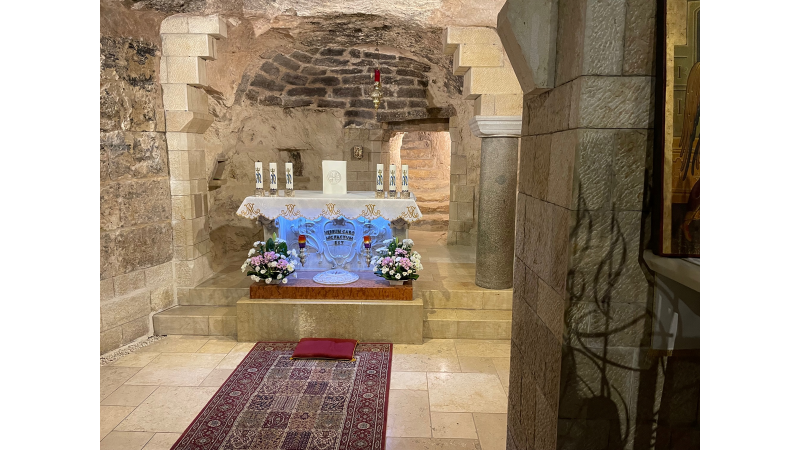
As we contemplate believing in God’s word, welcoming God’s Son, as Christmas dawns once again, I want to take us to where the angel visited Mary, the Church of the Annunciation in Nazareth. Note how everything is written in three languages so that many more can see and hear what happened when God’s messenger visited Mary. It a grand structure right in the middle of Nazareth. Churches on this site date back centuries. First, we go downstairs to the place believed to be where God’s messenger visited Mary. Note the opening in the ceiling you will see that later within the worship space up above. Here I wanted a selfie in this holy space. Then we line up to descend the steps to this gated off, holy of holy place. The remnants of the churches from the second century, Byzantine, and Crusader eras can be seen. After a moment to reflect, we ascended the steps to this sanctuary Right over the holy place there was a full worship service on this Tuesday afternoon at 3:00. Sometimes tours are granted access to hold a service in a religiously significant place.
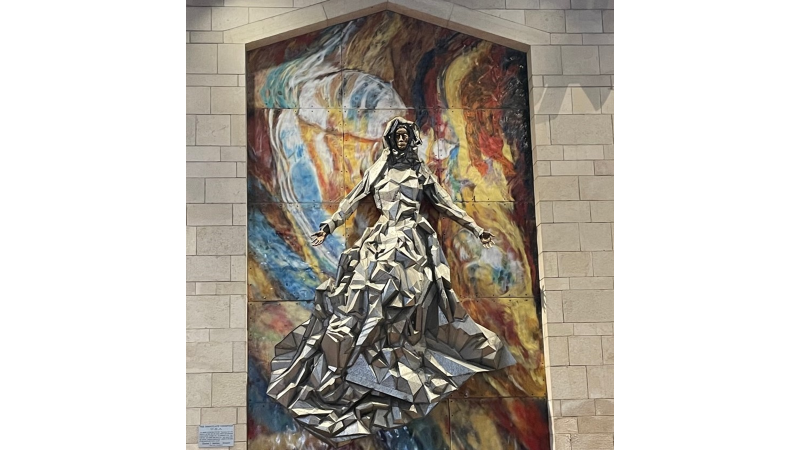
But it was the magnificent art in and around this Basilica that took my breath away. I have said before, we were encouraged to not just visit the dead stones of the churches and holy sites, but to meet and interact with the living stones, the people who dwell in and around Bethlehem and Nazareth. But here at the Church of the Annunciation it was the artistic stones that moved me. Christians from nations around the world gifted art pieces to be displayed here. Each one showing the culture, values, and theology of people. Along with their perspective of beauty. Portugal offered this tile work of Mary surrounded by children. Iraq and Andorra two other depictions. The Slovak Republic did not focus on Christ’s birth but his death and Mary’s presence. The Vatican places the Pope in prominence. Greece and Brazil display their religious and artistic sense. The United States also offered an expression of faith for this location. It is entitled, “The Woman Clothed with the Sun, by Charles Madden. Its inspiration is Revelation 12 which can be interpreted as Mary, Jesus’ mother, or the Church giving birth to the saints. Reading Revelation 12 is worth your time. I have never even thought about this passage, yet it hangs as a representation of our county at this church.
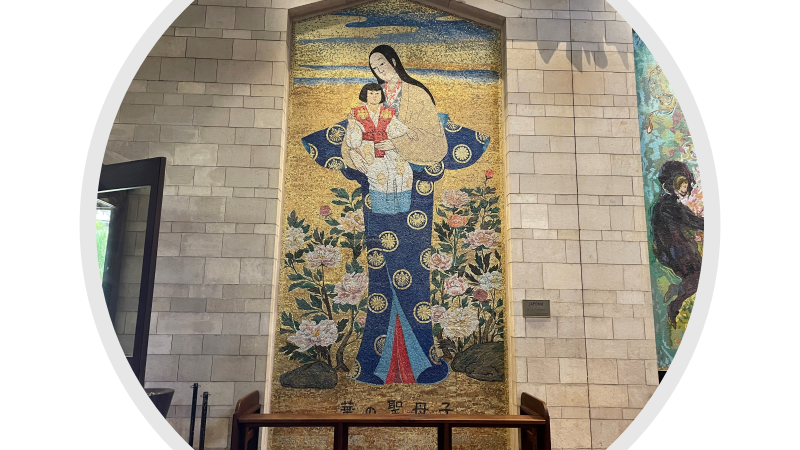
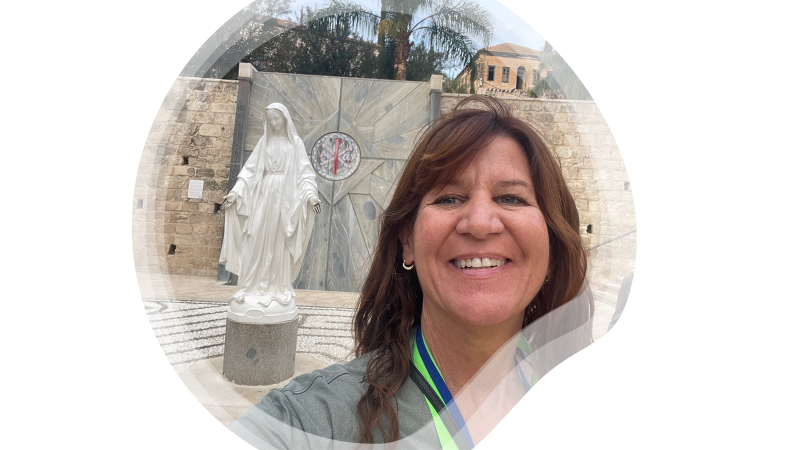
But the one I love the most, that stayed with me for years after seeing it in my 20s is this beautiful version of Mary and baby Jesus, from Japan. It was the first time I realized that Jesus is beyond race. That each culture sees Jesus through their own understanding of physical presence and ethnicity. It expanded the meaning of the creation passage, “God created us in God’s own image” (Gen. 1:27). It reframed our depiction of Jesus with blue eyes and sandy brown hair, not as problematic because we all know he was born a Jew, but as our seeing ourselves in the divine, in a way that we see ourselves in the mirror. Here is my take on that. A selfie with the marble statue of Mary in the courtyard. She is beyond race, beyond culture, beyond prejudice, an empty canvas upon which we can see and be seen by God.
So, this final Sunday in Advent, I pray you will know that God sees you, you are seen and heard by God. God favors you, just as you are. You are beloved, cherished, and precious. God’s perfect expression of that love is the gift we will soon celebrate, the birth of God’s only begotten Son. With Jesus’ life, death and resurrection we have become children of God, favored because God sees and hears us, loved because Jesus died for our sins, and blessed because we believe God’s word will be fulfilled, beautifully! Amen!
